
How Much Does a Sunroom Cost in Utah?
July 14, 2026 • Alex Lanis • Sunrooms
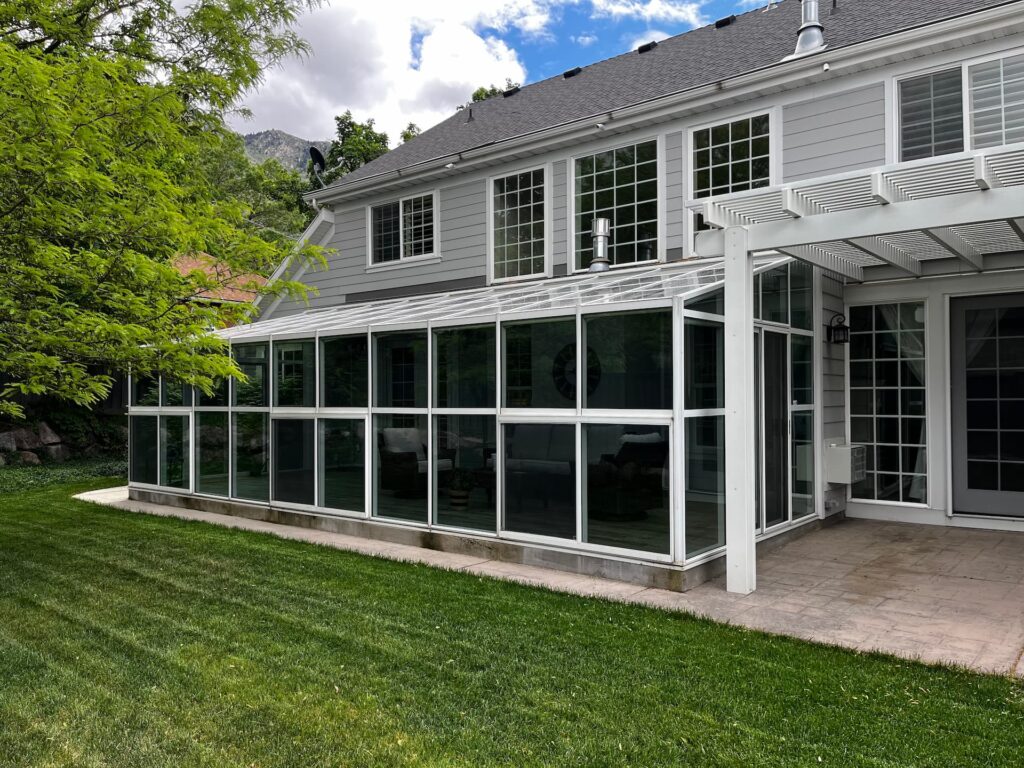
How much does a sunroom cost in Utah?
It’s the first question almost every homeowner asks us: how much does a sunroom cost?
It’s a fair question. You’re considering a significant investment in your home and you want to know what you’re getting into before you start the conversation. We respect that — and we’re going to give you a straight answer, even if it’s not the tidy number you were hoping for.
The honest answer is this: sunroom costs in Utah vary widely, and two projects that look nearly identical on paper can be dramatically different in price once the full scope is understood. What we can do is walk you through exactly what drives that cost, so you know what questions to ask and what to expect when you sit down with a contractor.
What Actually Drives Sunroom Cost
1. The Type of Sunroom
Not all sunrooms are built the same, and the type you choose is one of the biggest cost drivers.
A three-season room is designed for spring, summer, and fall use. It’s enclosed and protected from the elements but isn’t insulated or climate-controlled for year-round living. It’s generally the more accessible entry point.
A four-season room is fully insulated, climate-controlled, and built to be used year-round — including Utah winters. It requires higher-performance materials, better glass, and climate control integration, all of which add to the overall investment. For most Utah homeowners who want to actually use the space in January, a four-season room is the right answer.
A solarium or conservatory features floor-to-ceiling glass including the roof, creating a dramatic, light-filled space. It’s the premium end of the sunroom category and priced accordingly.
2. Size
This one is straightforward — a larger room costs more than a smaller one. But size interacts with everything else on this list. A larger four-season room with a complex roofline will cost significantly more than a smaller three-season enclosure on a flat site.
3. Foundation and Site Conditions
This is the factor that surprises homeowners most, and it’s one of the biggest variables in sunroom pricing.
If you have an existing concrete patio that can serve as the foundation, you save considerably. If the project requires a new foundation to be poured — whether because of site conditions, soil type, grade changes, or the scope of the addition — that adds meaningful cost to the project.
Site access, slope, and existing structure all factor in here. Two projects of identical size and style can have very different price tags simply because of what’s underneath and around them.
4. How the Structure Connects to Your Home
A sunroom isn’t a freestanding structure — it attaches to your existing home, and how that connection is made matters both structurally and financially. The complexity of tying into your existing roofline, wall framing, and interior affects labor, materials, and time on site.
5. Glass and Materials
The glass in your sunroom does a lot of work — it manages heat gain, UV exposure, insulation, and structural integrity all at once. At Four Seasons Home Improvements, we build with high-performance Four Seasons Sunrooms brand products, including low-E, thermally broken frames and high-performance glass engineered for real climates like ours.
Lower-cost options exist, but in Utah’s climate — with high UV exposure at elevation, summer heat, and genuine winter cold — the performance difference between standard and high-performance glass is felt every single day you use the room.
6. Snow Load Engineering
This one is specific to Utah and it’s non-negotiable. Every sunroom we build is engineered to meet the local snow load requirements for your specific location. Snow load requirements vary across the Wasatch Front — a project in the Salt Lake Valley has different engineering requirements than one in Park City or Ogden.
A contractor who isn’t accounting for local snow load requirements in their structural design is cutting a corner that has real consequences. Always ask.
7. Custom Features
Skylights, specialty lighting, electrical upgrades, custom finishes, upgraded hardware — these all affect total project cost. Some are purely aesthetic, some are functional, and some, like proper electrical for climate control, are essentially required for a four-season room to work as intended.
Sunroom Replacement: A Different Conversation
Not every sunroom project starts from scratch. Some homeowners have an existing sunroom that was built years or decades ago — and those older structures often come with real problems.
We recently completed a project in Ogden that illustrates this well. The homeowners had a two-story sunroom that had been there for years. Over time it had become everything a sunroom shouldn’t be: it leaked, it was unbearably hot in summer, and it was essentially unusable in winter because the old structure had no meaningful insulation or thermal performance.
We rebuilt it from the ground up as a true four-season room using Four Seasons Sunrooms products — including a cathedral ceiling on the second floor. The result was a space the family could actually live in year-round, with none of the problems that had made the old structure a liability.
Sunroom replacement projects like this involve their own set of cost considerations: demolition and removal of the existing structure, any repairs to the underlying foundation or connection points, and the full cost of the new build. But the result is a room that performs the way a sunroom is supposed to — for decades, not years.
If you have an older sunroom that leaks, overheats, or loses heat in winter, it’s worth having a conversation about whether a replacement makes more sense than a repair.
What About Return on Investment?
A well-built sunroom adds usable square footage to your home and consistently ranks as one of the home improvement projects with meaningful resale appeal. Beyond resale, the more immediate return is the room itself — homeowners who add sunrooms consistently report that it becomes the most-used room in the house.
That said, ROI depends heavily on quality of construction. A poorly built sunroom that leaks, overheats, or fails structurally doesn’t add value — it creates liability. The investment in quality materials and proper engineering isn’t just about comfort, it’s about making sure the project holds its value.
How to Get a Real Number
The only way to get an accurate cost for your specific sunroom project is a free in-home estimate. Every site is different, every home is different, and every homeowner’s goals are different. What we can do in that conversation is look at your space, understand what you’re trying to accomplish, and give you a real, honest number — not a ballpark that changes three times before you sign anything.
We serve homeowners throughout the Salt Lake Valley — including Sandy, Draper, Murray, and Cottonwood Heights — as well as Summit County, Davis and Weber Counties, and Utah County.
If you’re ready to start that conversation, call us at 801-452-6000 or book your free estimate online.
Four Seasons Home Improvements | Salt Lake City, UT | License #274722-5501